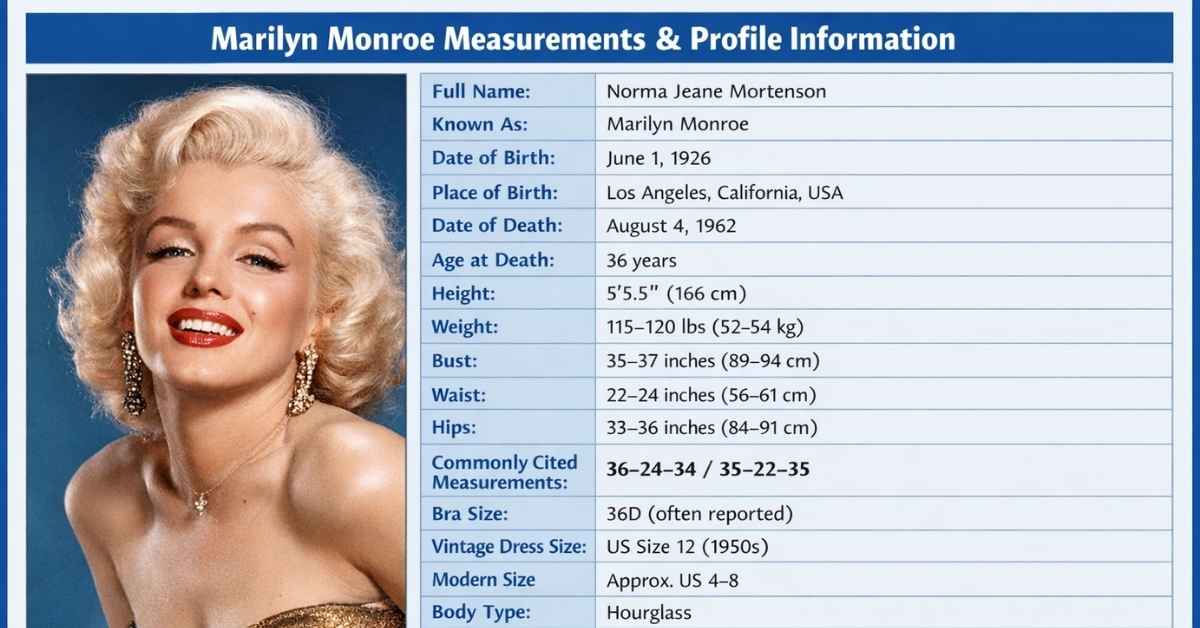
Marilyn Monroe measurements are most commonly cited as 35–37 inches (bust), 22–24 inches (waist), and 33–36 inches (hips), with a height of 5′5.5″ and a weight that generally ranged between 115–120 pounds. She was typically described as wearing a vintage size 12, which translates roughly to a modern US size 4–8. While numbers like 36–24–34 are widely repeated online, historical records show that her measurements fluctuated slightly over time.
Few figures in Hollywood history remain as discussed, admired, and mythologized as Marilyn Monroe. Her body proportions, dress size, and so-called “true size” continue to spark debates decades after her death. But what were her actual body measurements, and how do they compare to modern sizing standards?
This in-depth guide explores the facts, myths, and historical context behind her famous proportions — in a respectful, research-driven way.
Marilyn Monroe Measurements & Profile Info
| Category | Details |
|---|---|
| Full Name | Norma Jeane Mortenson |
| Known As | Marilyn Monroe |
| Date of Birth | June 1, 1926 |
| Place of Birth | Los Angeles, California, USA |
| Date of Death | August 4, 1962 |
| Age at Death | 36 years |
| Height | 5′5.5″ (166 cm) |
| Weight | 115–120 lbs (52–54 kg) |
| Bust | 35–37 inches (89–94 cm) |
| Waist | 22–24 inches (56–61 cm) |
| Hips | 33–36 inches (84–91 cm) |
| Commonly Cited Measurements | 36–24–34 / 35–22–35 |
| Bra Size | Often reported as 36D (varied by source) |
| Vintage Dress Size | US Size 12 (1950s sizing) |
| Modern Size Equivalent | Approximately US 4–8 |
| Body Type | Hourglass |
| Waist-to-Hip Ratio (Approx.) | 0.63–0.68 |
| Hair Color | Blonde |
| Eye Color | Blue |
| Profession | Actress, Model, Singer |
| Active Years | 1945–1962 |
What Were Marilyn Monroe Measurements?
The most reliable documentation suggests the following ranges during her prime years in the 1950s:
| Attribute | Commonly Reported Range |
|---|---|
| Bust | 35–37″ (often cited 35–36″) |
| Waist | 22–24″ (frequently 22–23.5″) |
| Hips | 33–36″ (commonly 35–36″) |
| Height | 5′5.5″ |
| Weight | 115–120 lbs |
| Bra Size | Often cited as 36D |
| Vintage Dress Size | Size 12 (1950s sizing) |
You may also see variations such as:
- 36–24–34
- 35–22–35
- 35.5″ bust, 23.5″ waist, 33.25″ hips
- 38–23–36 (studio publicity claims)
Why Do Her Measurements Vary?
There are several reasons:
- Studio publicity exaggeration
- Measurement rounding
- Weight fluctuations
- Different career phases
- Dressmaker vs studio records
Unlike today’s digital body stats, 1950s records weren’t always standardized. Tailors, costume designers, and studios often recorded slightly different figures.
Marilyn Monroe Height and Weight
How Tall Was She?
Marilyn stood at 5 feet 5.5 inches (approximately 166 cm). Some sources round it to 5′6″, but archival modeling records confirm the half-inch detail.
What Did She Weigh?
Her weight generally fluctuated between 115–120 pounds. Around major film productions, wardrobe records sometimes indicate minor increases or decreases depending on costume requirements.
Unlike modern celebrity culture, weight changes were common and not obsessively tracked. What stands out is her balanced body proportions, not a single static number.
BMI and Body Proportions
At 5′5.5″ and roughly 118 lbs, her BMI would fall within a healthy range. However, BMI alone doesn’t explain her shape. Her visual impact came from:
- A naturally defined waist
- Fuller bust and hips
- Balanced symmetry
This created the classic hourglass figure that became iconic.
Marilyn Monroe Dress Size Explained
One of the most misunderstood aspects of marilyn monroe measurements is her dress size.
What Was Her Vintage Dress Size?
She was most often documented wearing a size 12 in 1950s sizing.
What Would That Be Today?
Modern sizing is very different due to vanity sizing. A 1950s size 12 roughly corresponds to:
| 1950s Size | Modern US Equivalent |
|---|---|
| Size 12 | US 4–8 |
This is where the famous “size 16 myth” begins.
Was Marilyn Monroe Considered Plus-Size?
The short answer is no.
The confusion arises because:
- A 1950s size 12 is sometimes mislabeled as modern size 16.
- Modern size charts have shifted dramatically.
- Media outlets oversimplify comparisons.
In reality, by both 1950s standards and modern measurements, she was not plus-size.
The idea that she wore a modern size 16 is inaccurate and stems from misunderstanding vintage sizing.
READ MORE >>> Lara Trump Measurements, Height, Weight & Body Stats
Understanding 1950s Clothing Size Charts
Clothing sizes in the 1950s were based on:
- Bust measurement
- Waist measurement
- Hip circumference
- Proportional grading
Unlike today’s flexible sizing, garments were tailored and structured. A 22–23 inch waist was considered very small, even by 1950s standards.
Marilyn Monroe’s Body Type and Proportions
Marilyn is often described as having the ultimate hourglass figure.
Waist-to-Hip Ratio
Using average figures like 35–22–35:
Waist-to-hip ratio = 22 ÷ 35 = 0.63
This ratio is often cited in modern body proportion studies as aesthetically balanced.
Her body proportions were not extreme — they were symmetrical and proportionate.
Measurement Conversion: Inches to Centimeters
For global readers:
| Inches | Centimeters |
|---|---|
| 35″ | 88.9 cm |
| 22″ | 55.9 cm |
| 35″ | 88.9 cm |
| 5′5.5″ | 166 cm |
Providing metric conversions improves international SEO visibility.
Common Myths About Marilyn Monroe’s Measurements
Myth 1: She Was a Size 16
False — this is based on misunderstanding vintage charts.
Myth 2: She Always Measured 36–24–34
Her measurements fluctuated slightly.
Myth 3: She Was Overweight by Today’s Standards
Incorrect — her BMI was within a healthy range.
Myth 4: Her 36D Bra Size Was Confirmed
Bra sizing systems were inconsistent at the time.
How Her Measurements Influenced Beauty Standards
During the Hollywood Golden Age, slender yet curvy silhouettes dominated. Post-war fashion emphasized:
- Defined waists
- Structured bust lines
- Feminine curves
Marilyn’s body proportions helped popularize this look worldwide.
Her image shaped beauty ideals long before social media existed.
How to Achieve a Marilyn Monroe–Inspired Silhouette (Fashion Perspective)
Many people today search for marilyn monroe body measurements to recreate vintage fashion looks.
Key styling principles include:
- Emphasizing the waist
- Wearing structured undergarments
- Choosing tailored garments
- Selecting high-waisted silhouettes
It’s important to remember her look was achieved through professional tailoring and lighting, not just body shape alone.
Case Study: Vintage Size vs Modern Size
Let’s compare directly.
If Marilyn measured 35–22–35:
- Bust corresponds to modern US 4–6
- Waist corresponds to US 0–2
- Hips correspond to US 4–6
This demonstrates why labeling her as “plus-size” is inaccurate.
Timeline of Measurement Fluctuations
Early modeling career: leaner frame Mid-1950s film peak: fuller bust Late 1950s: minor fluctuations due to health
Her weight remained within a normal healthy range throughout most of her adult life.
Why the Debate Still Continues
The fascination with marilyn monroe measurements continues because:
- Vintage vs modern size confusion
- Social media reinterpretations
- Body positivity discussions
- Cultural nostalgia
Numbers become symbolic — but context matters.
Frequently Asked Questions
What were Marilyn Monroe measurements?
Most commonly cited ranges are 35–37″ bust, 22–24″ waist, 33–36″ hips, 5′5.5″ tall, and 115–120 lbs.
Was Marilyn Monroe really a size 16?
No. She wore a 1950s size 12, equivalent to modern US 4–8.
What was her bra size?
Often cited as 36D, though records vary.
How tall was she?
She stood 5 feet 5.5 inches tall.
What would her size be today?
Approximately US size 4–8, depending on brand.
Final Summary: The Truth Behind Marilyn Monroe Measurements
The truth about marilyn monroe measurements is far less dramatic than online myths suggest. Her body measurements most often fell within:
- 35–37″ bust
- 22–24″ waist
- 33–36″ hips
- 5′5.5″ height
- 115–120 lbs weight
- Vintage size 12
She was neither plus-size nor unusually proportioned by today’s standards. What made her iconic was not simply numbers — it was symmetry, styling, confidence, and cinematic presentation.
Understanding the difference between vintage sizing and modern vanity sizing is crucial. When viewed through accurate historical context, her measurements reflect a balanced, proportionate figure that defined an era.
Her legacy continues not because of inches or pounds, but because of presence, charisma, and cultural impact.